







Energy price impacts of the Iran conflict can’t be compared to the energy crisis: Here’s why
Accessing the latest energy information from a neutral expert source is paramount to navigating the markets from an informed perspective.
Surging energy prices have understandably been making headlines since the beginning of the Iran conflict; markets have rallied, with concerns over further escalation supporting geopolitical risk premia – the sum added to ordinary energy prices.
It could be easy to draw a connection between the current market situation and the last time rising energy prices were continuously in the news following a major geopolitical event – the 2022-23 energy crisis.
Although energy prices have spiked following the US and Israel carrying out strikes on Iran on 28 February 2026, the geopolitical price impacts are still a far cry from the heights of the energy crisis following Russia’s invasion of Ukraine. Let’s talk about why this is the case.
#1 Let’s compare how the two conflicts stack up price-wise.
The below graphic provides much-needed context about the strength, depth and extent of the high prices through the energy crisis when compared to the lesser up and down price movements we have seen over the recent weeks.
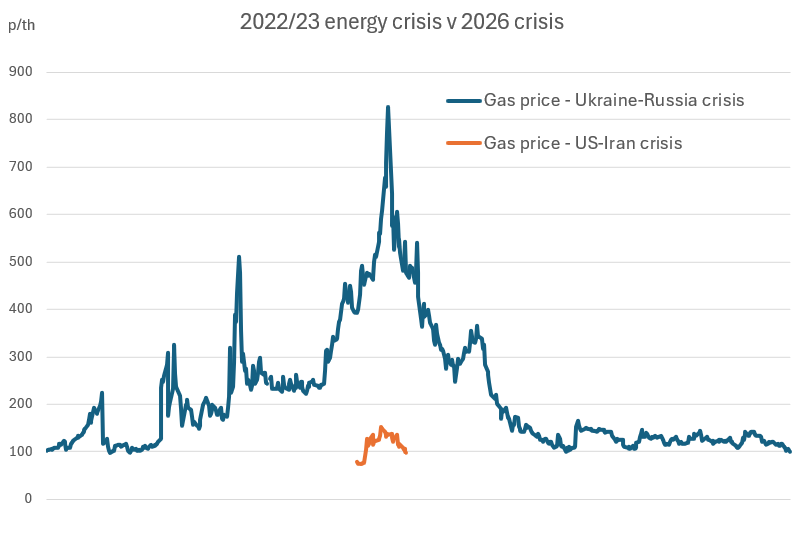
Although not widely reported in the news, Friday 17 April marked the lowest energy price day since the beginning of the Iran conflict.
For context, this price level for the front-season gas seen on this day is lower than the average of the last three calendar years.
#2: Energy price impacts are discussed a certain way for a reason.
Energy is a technical and complex market under constant fluctuation, with exact price impacts depending on factors like contract type.
This is an immense amount of nuance which needs to be condensed and simplified for the general audience within the constraints of a word count or allocated airtime.
However, the issue the public faces with their impression of energy price movements is that most responsive contracts are often used to illustrate price impacts of the Iran conflict, while prices subsequently coming down often goes unreported. This can create an impression that the prices are continuously surging.
#3: Let’s look at the nuance of fuel prices – UK gas and power versus oil
Fuels are often reported as one ‘basket’ or one concept. Meanwhile, the public has a real-life reference of rising oil prices at the petrol pump.
Yet, gas and power prices are lower on average this year compared to last year.
How can this situation be easily misinterpreted? Media reports often make no distinction between fuels or showcase the individual areas of each utility in their wider context.
If we examine each fuel individually however, this year’s oil prices have indeed challenged the highs we registered back in 2022.
Meanwhile, UK gas and power prices have remained at a fraction of their energy crisis-equivalent level. Forgoing this nuance can muddy the waters when making price comparisons between recent years.
#4: What about the forward markets?
Another useful comparison to draw between the price impacts of the Iran conflict and the energy crisis is the response and behaviour of the forward year markets.
This refers to the current available prices for supply contracts of the coming years, such as 2027, 2028 and 2029.
Through the height of the Iran conflict, the two year-ahead market (2028) has increased by 15% from normal levels this year.
However, around the peak high price times of 2022, the two-year forward market increased by around 750%.
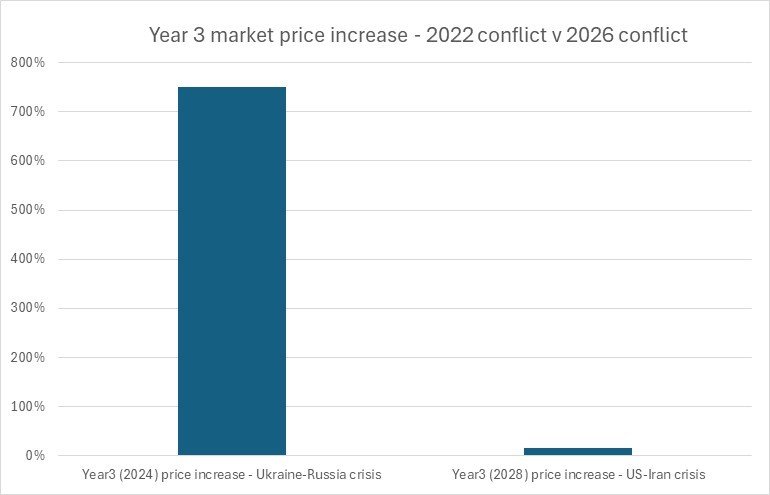
The stark contrast between these figures showcases that although the Iran conflict is ongoing, the market does not currently expect the disruption arising from this situation to present a longer-term concern to the energy supply.
What can we conclude from all this?
Comparing the two globally disruptive geopolitical events underlines the importance of accessing the latest energy information from a neutral expert source, so you can navigate the nuanced and continuously changing market space from an informed perspective.
Nevertheless, it’s vital to reiterate that the Iran conflict is ongoing – which means the situation can deteriorate and the price impacts will continuously evolve.
How can Inspired help?
Although the energy price impacts of the Iran conflict are worlds apart from the heights of the energy crisis, disruptive events like this can understandably cause concern and uncertainty around your next energy procurement decisions.
Regardless of the market situation, energy market is a technical, complex and highly volatile commodity space. Navigating this requires carefully examining the associated nuance through an industry expertise lens.
This is why Inspired’s market experts continuously analyse the global market movements to form expert insights to help our clients make informed decisions about purchasing energy at the right time in a continuously changing market.
For example, our risk management experts can help you create a bespoke energy procurement strategy for your business – tailored to your requirements and flexible enough to respond to a volatile market.
If you would like to discuss how our experts could best support you, please email us at [email protected]