







British Industrial Competitiveness Scheme: What do you need to know
Schemes like BICS are a critical opportunity to reduce your energy costs but this support comes with considerations.
Update – 10th August 2026:
The first BICS application window will run between 1 October and 30 November 2026: More information is available here.
Further details have been published about the eligibility requirements of the upcoming British Industrial Competitiveness Scheme (BICS) – due to commence in 2027.
First announced in last year’s Modern Industrial Strategy to support manufacturers with their electricity costs, the final design of BICS is set to mean more businesses can benefit from the scheme.
However, further guidance is yet to be published and the support available through BICS has strings attached – let’s untangle them.
What is the British Industrial Competitiveness Scheme (BICS)?
BICS seeks to reduce electricity costs for businesses operating in an eligible sector manufacturing at least one eligible product.
Eligible businesses are set to be exempt from paying the indirect costs of the Renewables Obligation (RO) and Feed-in Tariffs (FiT) from April 2027 and the Capacity Market (CM) schemes from October 2027.
According to the Department of Business and Trade, this exemption is set to be worth around £35–£40 per MWh. However, your level of exemption depends on electricity use involving manufacture of eligible products on site.
My business could be eligible for BICS – where should I start?
Schemes like BICS are a critical opportunity to reduce your energy costs. However, the available support comes with caveats and considerations.
Here are three things you should consider before applying for the scheme:
#1: Consumption data is key.
Your level of exemption depends on the percentage of your eligible electricity usage. This requires accurate and current data to showcase your relevant consumption on site – which means effective metering is vital.
Once all this data is coming in, it must be accessible and easily turned into reporting outputs to demonstrate your compliance with the scheme.
#2 Scrutinise your energy usage.
Taking control of your usage is key to reducing your energy costs, including optimising your usage so you can consume energy more efficiently.
Becoming more energy efficient also ties in with BICS; removing any wastage and optimising energy usage of your sites could impact the level of relief you are entitled to.
Examining your overall consumption can help ensure your usage focuses on the relevant manufacturing activities – eligible for exemptions – while using less overall.
#3 Compliance with levy exemption schemes is a continuing commitment.
A successful application is not the end point. Participation in schemes like BICS requires sustained and consistent effort – placing demands on your internal resources.
For instance, reporting and data requirements to claim exemptions are becoming increasingly complex and frequent.
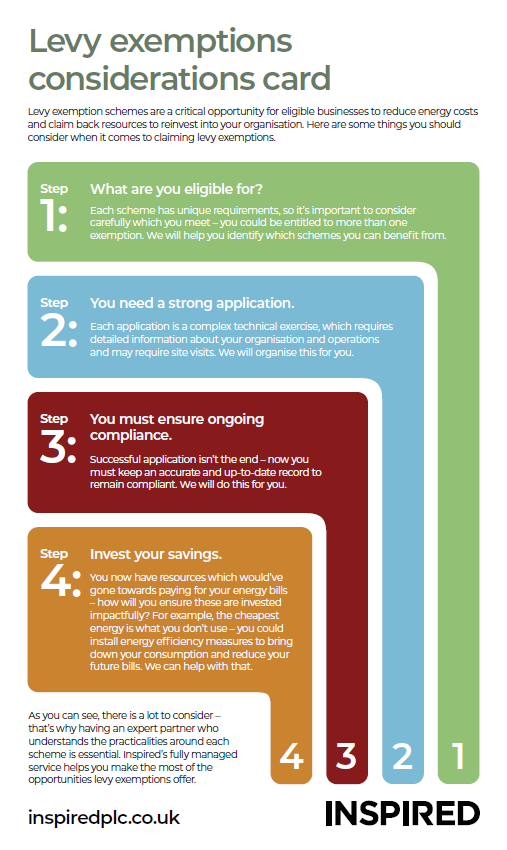
In fact, there is a lot to consider when it comes to claiming levy exemptions – this infographic tells you more.
What happens next?
The government intends to implement BICS by amending the existing secondary legislation establishing the RO, FiT and CM schemes.
These changes are expected to be made by autumn – subject to parliamentary approval, subsidy control procedures and a further consultation.
Department for Business and Trade has launched a consultation seeking views on the proposed regulatory changes and approach to scheme delivery for BICS. This closes on 14 May 2026.
How can Inspired help?
Manufacturers navigate a challenging industry landscape of rising energy costs, tightening environmental scrutiny and continuously evolving regulatory landscape – all the while keeping daily operations running.
Although BICS presents an opportunity to address one of the key issues impacting the industry, creating a successful application and ensuring ongoing compliance with an additional scheme can seem like a formidable challenge.
This is where Inspired can support you. As part of our levy exemption service we carry out a site audit, where we can identify the solutions required to bolster your compliance with BICS. Our fully managed service includes:
- Eligibility assessment: We will determine which levies your organisation could apply for – not just BICS – and recommend next steps.
- Technical assessment: We will assess your processes to ascertain the maximum discounts and all exemptions attainable.
- Application: We’ll complete your application(s); reclaim any historical savings you are entitled to, as well as secure maximum ongoing savings.
- Ongoing obligations: We will take care of your ongoing commitments, including review, administration, reporting and validation – reducing your administrative burden.
With an extensive suite of solutions and services under one roof, Inspired can offer your business comprehensive support across all aspects of your consumption, from effective metering solutions to optimising your energy usage.
Are you ready for BICS? If you would like to discuss your eligibility or find out more about how our experts could best support you, please email us at [email protected]